
You open Instagram, tap someone’s followers list, and wonder: why is this person at the top? Or you check your own following list and notice the order keeps changing. Is it chronological? Random? Does it show who’s stalking you?
Here’s the direct answer: Instagram following list order is NOT chronological — and it never has been. It uses a personalized engagement algorithm. And Instagram has not officially confirmed exactly how the ranking works, but enough testing has been done to explain the core factors clearly.
This guide breaks down exactly how Instagram sorts follower and following lists in 2026, why every viewer sees a different order, and what you can do about it.
If you want to see who doesn’t follow you back, you can use our free Instagram unfollowers tracker tool.
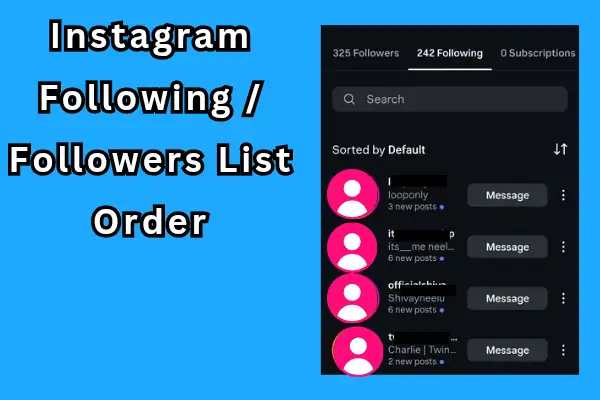
Quick Answer: Instagram following list order is based on your engagement with each account — likes, story views, DMs, comments, and profile visits. The most interacted-with accounts appear first. It is personalized to each viewer and is NOT in chronological order.
Is There an Algorithm, or Is It Random?
The Instagram following list order is not random. It’s also not alphabetical (unless you have fewer than 200 followers — more on that below). And it’s definitely not showing you who viewed your profile the most.
Instagram uses machine learning to sort both your followers list and your following list. The algorithm is personalized — meaning your following list order is completely different from your friend’s, even if you both follow the same accounts.
Important note: Instagram has never made an official public statement about how the following list or followers list is ordered. The Meta Help Center does not confirm the exact ranking factors. What we know comes from systematic community testing and observation — not an official disclosure.
Followers List vs Following List: They Work Differently
Most people miss this: your Instagram followers list order and your Instagram following list order use different algorithms. They are not the same.
- Your Followers List — shows people who follow YOU. The order is based on the viewer’s engagement with those followers.
- Your Following List — shows people YOU follow. The order is based on YOUR engagement with them.
This matters because the order changes depending on who is looking. When you look at someone else’s followers list, you see it sorted by YOUR relationship with those accounts — not by theirs.
| Aspect | Followers List Order | Following List Order |
|---|---|---|
| What it shows | People who follow you | People you follow |
| Who can see it | Anyone (if public) | Only you (private by default) |
| Order based on | Viewer’s engagement with those accounts | Your engagement with those accounts |
| Personalized? | Yes — each viewer sees different order | Yes — only you see your version |
| Under 200 followers | Alphabetical (A–Z) | Alphabetical (A–Z) |
| Over 200 followers | Engagement-based algorithm | Engagement-based algorithm |
| Main ranking factor | Engagement with that person’s content | Your engagement with their content |
How Instagram Orders Your Followers List
When someone visits your profile and taps your follower count, the order they see is based on their behavior — not yours. Two different people looking at your followers list will see completely different orders.
Factor 1: Engagement Frequency
The primary signal. If a viewer frequently likes, comments on, and shares content from one of your followers, that follower appears higher in the list. Inactive accounts — people who rarely engage — sink to the bottom.
Factor 2: Recent Interactions (Last 7–14 Days)
Recency matters more than total history. If someone engaged with content just two days ago, they rank higher than someone with older but more total interactions. Instagram heavily weights what happened recently.
Factor 3: Mutual Connections
Followers who are mutual friends with the viewer — people you both follow or interact with — appear higher. Instagram treats shared connections as a relevance signal.
Factor 4: Profile Visits
Instagram tracks profile visits in the backend. If someone regularly visits a specific follower’s profile, that follower ranks higher in the viewer’s version of the list. This data is not shown to users, but it is used in the algorithm.
Factor 5: Direct Messages
DM activity is a strong signal of real-world relationship. Accounts you DM frequently are ranked much higher in the list. This is one of the strongest factors Instagram uses.
Factor 6: Story Views and Reactions
Consistently watching someone’s stories — especially reacting to them — pushes that account higher. Story engagement is weighted heavily because it requires intent (you have to actually watch).
Factor 7: Account Age and Activity Level
Brand new accounts and inactive/ghost accounts rank lower. Established, active accounts rank higher. Dead accounts drift toward the bottom over time.
How Instagram Orders Your Following List
Your Instagram following list order — the list of people YOU follow — is private. Only you see it in this personalized order. When someone else looks at your following list, they see it sorted by their own engagement signals, not yours.
Factor 1: Your Engagement With Them
Accounts you interact with most frequently appear at the top. If you watch someone’s stories every day and like their posts regularly, they’ll be near the top of your following list. Someone you followed two years ago and never interacted with will drift to the bottom.
Factor 2: Recent Interactions
Just like the followers list, recency matters. An account you interacted with yesterday ranks higher than one you interacted with last month, even if that account has more total interactions over time.
Factor 3: Relationship Proximity (DMs and Tags)
Instagram identifies close relationships through DM frequency, tagging, and mention activity. Close friends and family — even if not officially marked as “Close Friends” — get priority placement in your following list order.
Factor 4: Similar Interest Clusters
If you follow a group of accounts in the same niche — say, fitness, or travel — Instagram sometimes clusters similar accounts together in your list. This is a weaker signal but present in the algorithm.
Factor 5: Mutual Connections
People who are connected to your broader friend network appear slightly higher. This is Instagram’s way of surfacing accounts that are socially relevant to you.
2026 Instagram Following List Order: Algorithm Factor Breakdown
Based on community testing and observation, here is the approximate weight each factor carries in the Instagram following and followers list order algorithm in 2026. Note: Instagram has not officially confirmed these percentages — this is based on reverse-engineering and pattern analysis.
| Ranking Factor | Approximate Weight | What Triggers It |
|---|---|---|
| Engagement frequency (likes, comments, shares) | ~40% | Regularly interacting with their posts |
| Recent interactions (last 7–14 days) | ~30% | Any engagement within the past 2 weeks |
| Mutual connections and network overlap | ~15% | Shared followers, same community |
| Story views, DM activity, profile visits | ~10% | Watching stories, sending DMs, visiting profiles |
| Account age and activity level | ~5% | How active and established the account is |
The biggest takeaway: engagement frequency and recency together account for roughly 70% of the ranking signal. If you want an account to appear higher in your following list, simply interact with their content consistently for 1–2 weeks and you’ll see the change.
The 200-Follower Threshold: Where Everything Changes
Here is something Instagram does not publicly advertise:
- Under 200 followers: Your followers list is ordered alphabetically by username. A to Z. No algorithm.
- Over 200 followers: The engagement-based algorithm takes over completely. The list is no longer alphabetical.
This is why many new accounts see a perfectly ordered A-to-Z followers list, then suddenly it changes once they cross 200. It can feel like a bug or a setting change — but it’s just Instagram switching from alphabetical to algorithmic ordering.
The same threshold applies to the following list. Under 200 accounts followed: alphabetical. Over 200: algorithm-based.
Why 200? Likely because the algorithm needs enough data points to be meaningful. With 50 followers, engagement signals are too sparse for reliable ranking. At 200+, the algorithm has enough data to create useful personalization.
Did Instagram Change the Follower Order? (2021–2026 Timeline)
Yes — Instagram has changed how follower lists are ordered multiple times. Here is a brief timeline of what changed and when:
2016: The Shift Away From Chronological
Instagram’s main feed moved away from chronological order in 2016. Around the same time, follower and following lists also began shifting toward engagement-based signals, though this happened gradually and quietly.
2019–2020: Personalization Deepens
The algorithm became more personalized. The same followers list started showing different orders to different viewers. Story views and DM signals became stronger ranking factors during this period.
2021: The Biggest Noticeable Shift
2021 is when most users noticed the change and started searching “did Instagram change follower order 2021.” The answer: yes. The algorithm weighting shifted, giving more priority to recent interactions over total historical engagement. Many people saw their list order change significantly overnight — not because of a setting change, but because the algorithm updated.
2022–2024: Refinement and Mutual Connections
Mutual connection signals were strengthened. Accounts in your network — people who know people you know — started appearing higher. Instagram also added stronger signals for Close Friends activity.
2025–2026: Current State
The algorithm is now more responsive to short-term engagement. Recent activity (last 7–14 days) carries more weight than older history. The personalization is deeper — two people with completely different engagement patterns see almost entirely different list orders, even on the same profile.
Can You See Instagram Followers in Chronological Order?
This is one of the most searched questions — and the honest answer is: not exactly, but there are limited options.
The Default List Is Not Chronological
The default follower and following list order is algorithm-based, not chronological. You cannot simply scroll the list and assume the people at the top are your newest or oldest followers.
Sort Options Instagram Provides
Instagram does have a sort feature inside the followers/following list. On the app, after opening the followers list, you may see a “Sort” option that includes:
- Default — the personalized algorithm order
- Earliest — roughly oldest followers first (closest to chronological)
- Latest — newest followers first
These sort options are available on some versions of the Instagram app (Android and iOS). Not all users see them depending on their app version and region rollout.
Third-Party Tools
Some third-party tools and apps claim to extract your followers list in chronological order. However, these often violate Instagram’s Terms of Service, may require login access to your account, and can be a security risk. Use with caution — or avoid entirely.
The Practical Reality
If you want to see your newest followers, the easiest method is to check your Activity/Notifications tab — new followers show up there in real-time order. This is more reliable than trying to sort the full followers list.
Why Everyone Sees a Different Order: The Personalization Factor
This is the most important thing to understand about Instagram following list order: there is no universal “true” order.
When you visit someone’s profile and check their followers, you see a version of that list sorted by YOUR engagement. Your friend visiting the same profile sees a completely different order based on THEIR engagement. The profile owner sees yet another order.
Example: You and your colleague both check your boss’s Instagram followers list. You see your mutual friend Alex at the top because you interact with Alex all the time. Your colleague sees a completely different person at the top — someone they know. Your boss sees yet another order based on who has engaged with them most recently.
Three people, three completely different lists — same followers, different order for everyone.
This is also why the “following list stalker” myth exists. People assume someone must be at the top because they’ve been viewed recently. In reality, they’re at the top because of long-term engagement signals — not because they just viewed your profile.
Myth-Busting: What Instagram Following List Order Is NOT
Myth 1: “It shows who stalked you”
False. Instagram tracks profile views internally, but that data is NOT surfaced to users and is NOT the primary factor in follower list order. The order reflects engagement — likes, comments, DMs, stories — not profile visits alone. Anyone claiming the follower list order reveals your “stalkers” is wrong.
Myth 2: “It’s in chronological order — newest followers first”
False. Instagram following list order is not chronological. If it were, the list would change constantly every time someone new followed you. The algorithm-based order changes more slowly, based on engagement pattern shifts. The person at the top of your list today may have followed you years ago.
Myth 3: “Everyone sees the same order”
False. As explained above, the Instagram following list order is personalized for each viewer. There is no universal order. Two people looking at the same profile’s followers list will almost always see a different arrangement.
Myth 4: “Just following someone moves them to the top”
Partially false. Following someone creates potential for interaction, which can eventually influence rankings. But simply hitting “Follow” does nothing to list order. You need to actually engage — watch stories, like posts, send DMs.
Myth 5: “Blocking and unblocking someone changes the order”
False. Blocking removes someone from your list entirely. Unblocking them brings them back, but at a position based on engagement history — not at the top or bottom. Blocking/unblocking other unrelated people has no effect on anyone else’s position.
Myth 6: “Instagram confirmed how the list is ordered”
False. Instagram has not made an official statement about how the followers list or following list is ordered. The Meta Help Center does not disclose the algorithm. Everything shared about ranking factors is based on community testing and pattern observation — not official Instagram documentation.
How to Appear Higher in Someone’s Followers List
If you want to rank higher in a specific person’s followers list — so they see you near the top when they check — the strategy is consistent engagement. Here is what actually works:
- Watch their stories consistently — story views are one of the strongest ranking signals. Watch their stories every time they post for 2–3 weeks.
- Like their posts regularly — not every single post, but consistent engagement. Every 2–3 posts works.
- Comment meaningfully — actual comments (not just emojis) signal a stronger relationship to the algorithm.
- Send DMs — DM activity is weighted heavily. Even a brief, genuine message signals a real connection.
- Visit their profile — occasional profile visits contribute to the signal, though this is a weaker factor than DMs and story views.
- React to their stories — reactions to stories are treated as higher-intent engagement than passive views.
Timeline: Consistent engagement over 1–2 weeks is usually enough to see a change in your position in their list. The algorithm responds to recent behavior more than historical behavior.
There is no shortcut. Tools claiming to “boost” your position in someone’s followers list by generating fake engagement signals do not work and risk your account being flagged.
FAQ: Instagram Following List Order — Common Questions Answered
Why does my following list look different every time I check?
Because the order is based on your engagement patterns, which change daily. If you interacted with Alex heavily yesterday, Alex moves up. If you haven’t interacted with someone in two weeks, they drift down. The list reflects your current relationship signals — so it updates as you do.
Is the Instagram following list order the same on phone and desktop?
Generally yes, with minor differences. The core algorithm is the same, but slight variations can appear between Android, iOS, and the desktop web version. The overall order should be very similar across devices for the same account.
Does the order of someone’s following list mean anything?
Only from the perspective of the viewer. If you’re looking at someone’s following list and see people you know at the top — that’s your engagement with those people, not a signal about the account owner’s relationships. The order you see reflects YOU, not them.
Can I sort my followers list differently?
Instagram provides limited sort options: Default (algorithm), Earliest (oldest followers), and Latest (newest followers). These are accessible via the sort button inside the followers list on some app versions. Beyond these built-in options, you cannot manually sort your followers list.
Does Instagram show me who views my profile in the followers list?
No. Instagram does not show profile view data to regular users. While Instagram tracks profile visits internally, this data is not displayed in the followers list. Third-party apps claiming to show “profile viewers” are not using real Instagram data and are unreliable.
Why does the following list on Instagram change order?
The order changes because your engagement patterns change. Whoever you interact with most in the recent 7–14 days moves higher. The algorithm continuously re-evaluates based on your latest behavior, so the list is never static.
Who are the people at the top of someone’s following list on Instagram?
The people at the top of someone’s following list — from YOUR perspective — are people you interact with the most. From the account owner’s perspective, their top accounts are people THEY interact with the most. The “top” position is entirely viewer-dependent.
Does Instagram sort someone’s following list differently for different viewers?
Yes, absolutely. The Instagram following list order is personalized for each viewer. Two different people looking at the exact same following list will see completely different orders based on their individual engagement history with those accounts.
Why do they appear on my followers list but I’m not on their following list?
This simply means they follow you but you do not follow them back. It’s a one-way follow. The followers list shows everyone who follows you. The following list shows who you follow. These are independent — you don’t need to follow back for someone to follow you.
What does “sort by default” mean on Instagram?
“Sort by default” on Instagram means the algorithm-based order — the personalized engagement ranking. It’s the opposite of the sort options like “Earliest” or “Latest.” Default = algorithm. The algorithm considers engagement frequency, recency, mutual connections, and relationship signals.
The Bottom Line: Instagram Following List Order in 2026
Here is the complete summary of everything you need to know:
- Instagram following list order is not chronological — it’s engagement-based.
- Instagram has not officially confirmed the algorithm. What we know is based on testing.
- The order is personalized — every viewer sees a different version of the same list.
- Accounts with under 200 followers see alphabetical order. Over 200: algorithm kicks in.
- The top ranking factors are engagement frequency (~40%) and recent interactions (~30%).
- Instagram changed the follower order significantly around 2021, shifting to recency-weighted personalization.
- You cannot easily see followers in chronological order by default, but limited sort options exist in some app versions.
- The list does not reveal stalkers — that is a persistent myth.
Want to appear higher in someone’s list? Engage with their content consistently. Want to understand why your own list looks the way it does? Look at your recent interaction history — that’s your answer.
Still confused about something specific? Drop your question in the comments below — we answer everything.